Stop Working on Everything. Work on What Matters Next.
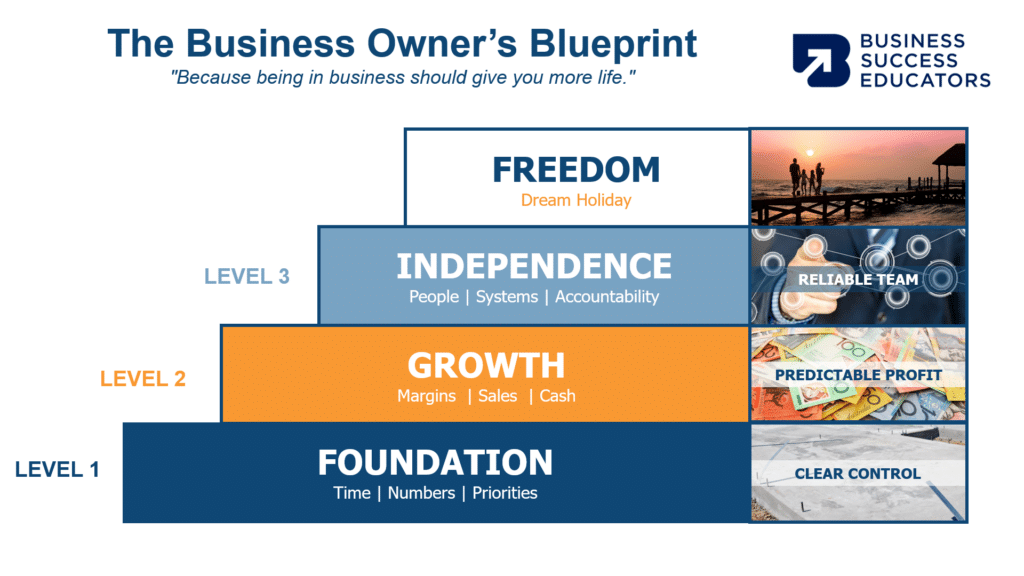
In an established business there is never a shortage of things you could improve. Margins, systems, delegation, reporting, sales. Try to fix everything at once and very little changes. The Blueprint shows you what is actually holding the business back, and what deserves your attention now.
Nine business disciplines. Three levels of development. A much clearer order of priorities.
The Problem Isn't Usually Knowing What You Could Improve
Most business owners can tell you ten things that need work before you’ve finished your first coffee.
The harder question is: which one should we fix first?
Because business problems are connected. You may think you need better staff when the real issue is role clarity. You may chase more sales when the real problem is pricing or job profitability. Treat symptoms instead of causes and you can stay very busy improving the business without making it better. The Blueprint exists to prevent that.
How The Blueprint Works
Look at the Whole Business Before Deciding Where to Work
Rueben’s engineering background shapes the Blueprint. When part of a system underperforms, you do not start replacing components at random. You find the constraint. A business is no different. Profit, team, leadership, systems, workload and direction are connected, and a weakness in one usually creates pressure somewhere else. Once you can see those relationships, the next move is much easier to identify.
The Nine Business Disciplines
Work the hours you choose and free up a day to work on the business.
Understand your numbers so you can make confident financial decisions.
Get clear on what matters most so every week moves you forward.
Build a model that makes more profit with less effort.
Build a marketing and sales engine that hits target consistently.
Build a cash surplus that funds the business and your life.
Get the right people in the right roles so the business runs smoothly.
Document how the business works so the team delivers consistently.
Create the rhythm and structure that keeps the team performing.
Not Every Business Needs to Operate Like a $20 Million Company
Owners are constantly shown systems and structures designed for businesses at a completely different stage. More structure is not always better. A five-person company does not need every layer of management a 50-person company needs. That is why the Blueprint measures each discipline across three levels of development.
The aim is not to score as highly as possible. It is to develop each part of the business to the level this business actually needs.
Sometimes the Thing You Think Is Wrong Isn't the Problem
Imagine the owner is working 70 hours a week. The obvious conclusion is that they need to delegate more.
Maybe. But why aren’t they delegating?
Perhaps the team does not know what decisions it owns.
Perhaps there are no clear numbers for the owner to monitor once they step away.
Perhaps processes live entirely in the owner's head.
Perhaps they hired people to perform tasks but never developed anyone capable of taking responsibility.
“Delegate more” is technically correct and completely useless until you understand what is stopping it from happening.
That is what diagnosis is for.
Find the Constraint. Then Put the Work in Order.
Once we can see where the business stands, we can start making choices.
What needs attention now?
What would make the greatest difference if we fixed it?
What problem is creating several other problems?
What should we deliberately leave alone for the moment?
That last question matters. A good plan does not only tell you what to do. It gives you permission to ignore what is not important yet. That focus is what makes implementation likely.
See The Blueprint In Action
Let Rueben Walk You Through It
In this video, Rueben explains the nine disciplines, the three levels and how the Blueprint is used to work out where an established business should focus next.
From Blueprint to Business Game Plan
The Blueprint is not designed to produce an impressive report that sits in a folder. We use it to make decisions. In a Business Game Plan Session, Rueben works through the business with you, finds the constraints that deserve attention first and turns a complex business into a short list of priorities.
You don’t need to fix the whole business today. You need to know which changes will make the next ones easier.